CNC robots from Switzerland: high-precision manufacturing solutions
by MABI Robotic

contact us
arrow
About us

MABI Robotic AG has made a name for itself as a leading Swiss company in CNC robotics. The company is part of the MABI Group and combines Swiss engineering expertise with innovative robot technology

The focus is on the MAX series — a robot system with secondary encoder technology, increased stiffness and Siemens SINUMERIK control. The high-precision CNC robots are developed for subtractive and additive manufacturing processes and produced locally in Veltheim.

As one of the few manufacturers with local development, production and assembly, MABI Robotic stands for the highest quality standards. Since its founding, the team has pursued the goal of shaping the robotics market through continuous innovation and opening up new opportunities for manufacturing companies.

+
35
Successful
completed projects
100
%
Shares
at the company
+
80
Certified experts
in the Mabi Group team
2012
On the
Market since
1
First series manufacturer of high-precision CNC robot systems

MAX series: CNC robot with secondary encoder technology

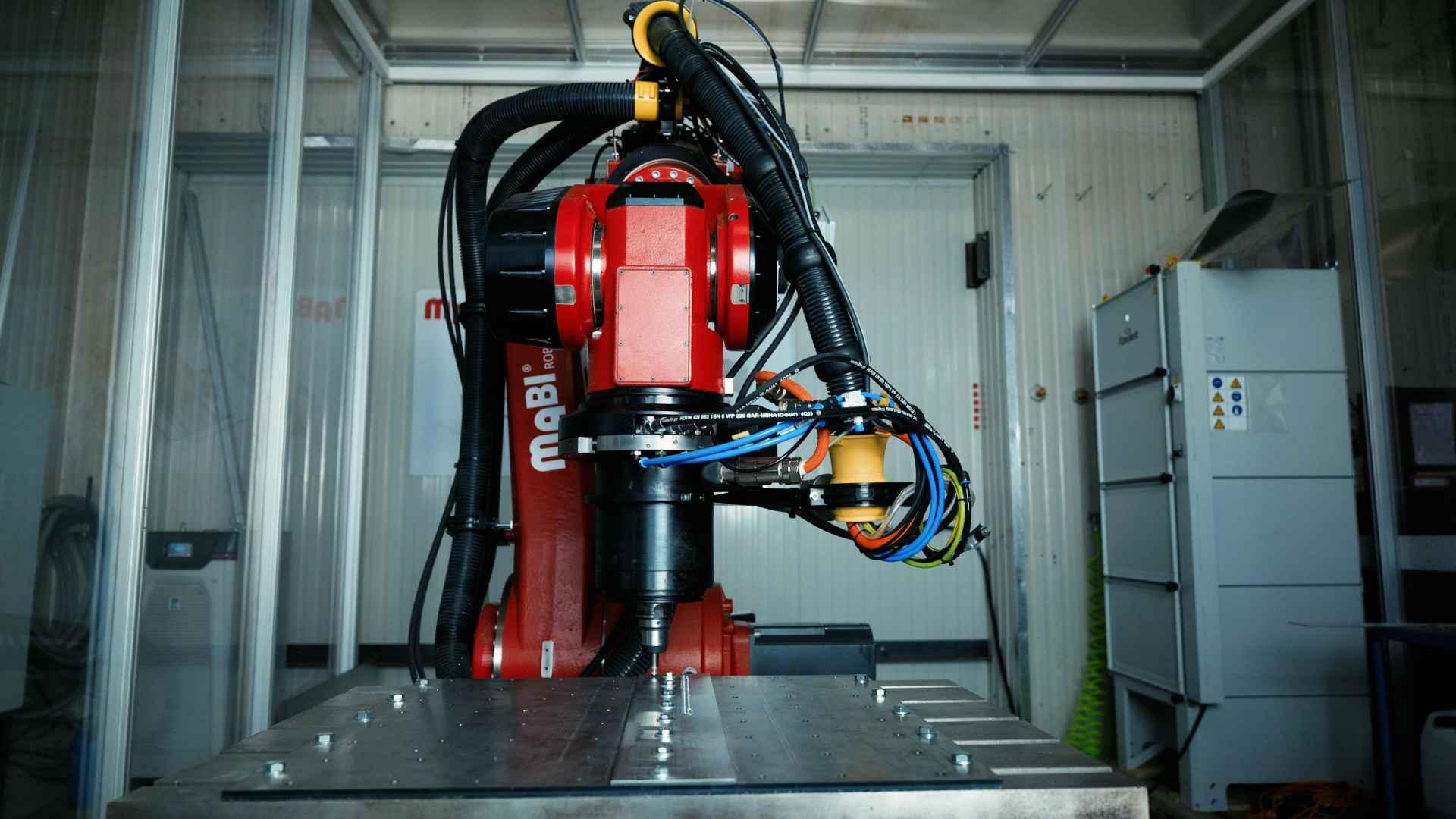
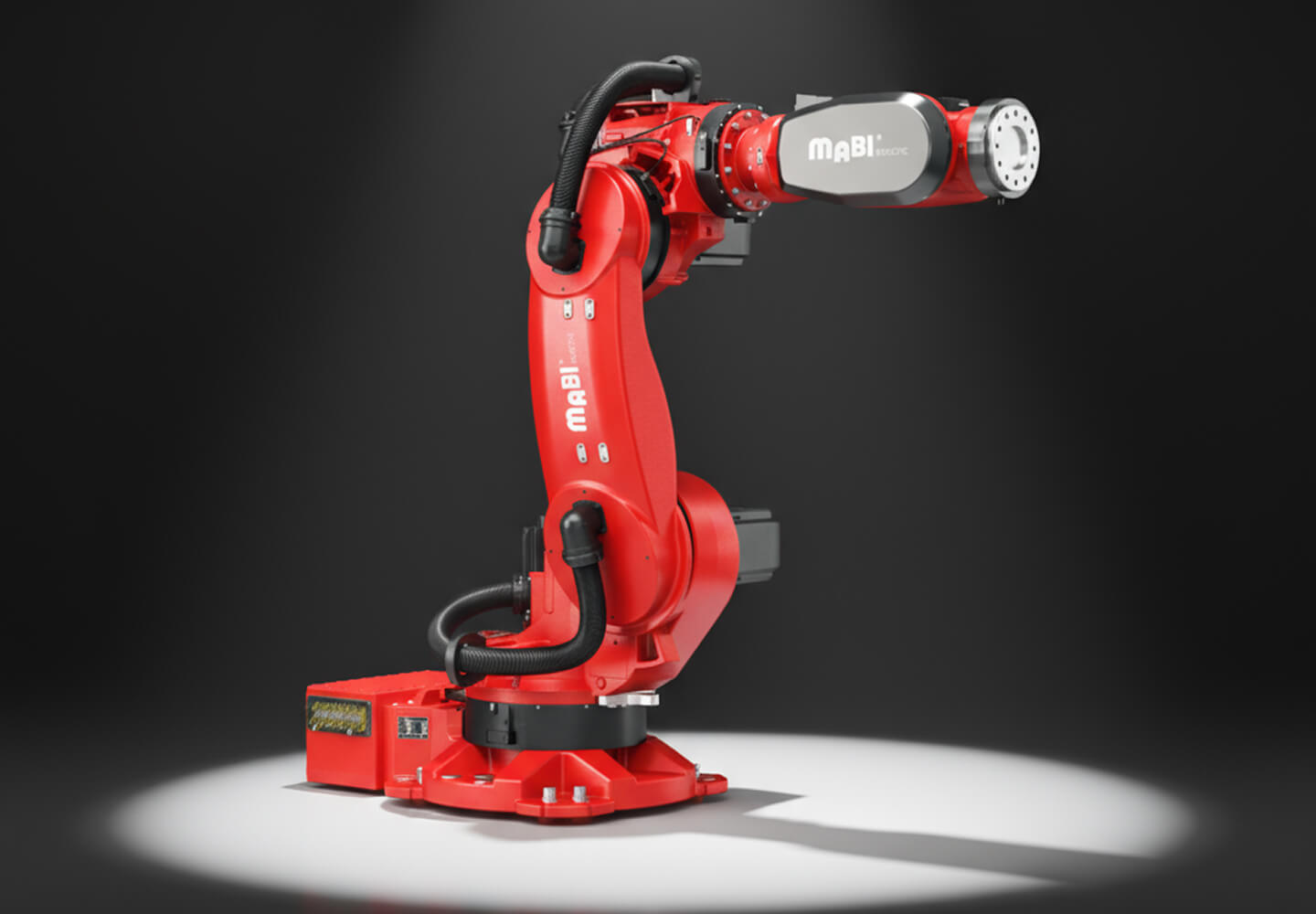
The MAX-100-2.25-P industrial robot is at the heart of the portfolio. The system was developed specifically for machining processes and is fundamentally different from converted standard robots. With a payload of 100 kg and a range of 2.25 meters, the CNC robot processes demanding workpieces made of aluminum, steel, wood, plastic and carbon fiber. The high load capacity makes it possible to use powerful WEISS milling spindles with an output of up to 16.5 kW.

What secondary encoders do:

Standard robots only measure positions close to the engine. The MAX series also measures on the output side of each axle. The system compensates for twisting and mechanical tolerances in real time. As a result, the CNC robots achieve a repeatability of ±0.02 mm — even in dynamic milling processes with high process forces. The increased rigidity of the kinematics reliably absorbs milling forces, where converted standard robots significantly lose precision under load. Each system is factory-calibrated with a Leica Laser Tracker and achieves a pose accuracy of ±0.15 mm over the entire working area.

Siemens SINUMERIK: CNC control without teaching

MABI Robotic consistently uses Siemens SINUMERIK 840D sl and SINUMERIK ONE. Programming is carried out using Siemens NX CAD/CAM software with G-code post-processor.

The workflow is similar to a conventional CNC milling machine: load STEP file, define processing strategy, generate G-code. The time-consuming teaching is completely eliminated. CNC experienced specialists can immediately work productively.

Benefits of Siemens integration:

  • Open architecture for integration into Siemens environments
  • Compatibility with existing CAM workflows
  • Continuous processes from CAD to control
  • Reduction of set-up times

Expanded processing areas: linear axes and rotary swivel tables

For large components, the MAX-100 can be combined with the MLR-2500-P linear axis. The working area is extended to 6 x 2 meters. The linear axis can be extended in steps of 3 or 5 meters. The MMT-500-DD rotary swivel table creates complete processing cells for complex welded structures or battery trays from electric mobility. The combination achieves accuracies that are comparable with portal milling machines — with significantly lower investment costs and reduced space requirements.

Linearachsen

Areas of application of our
CNC robot

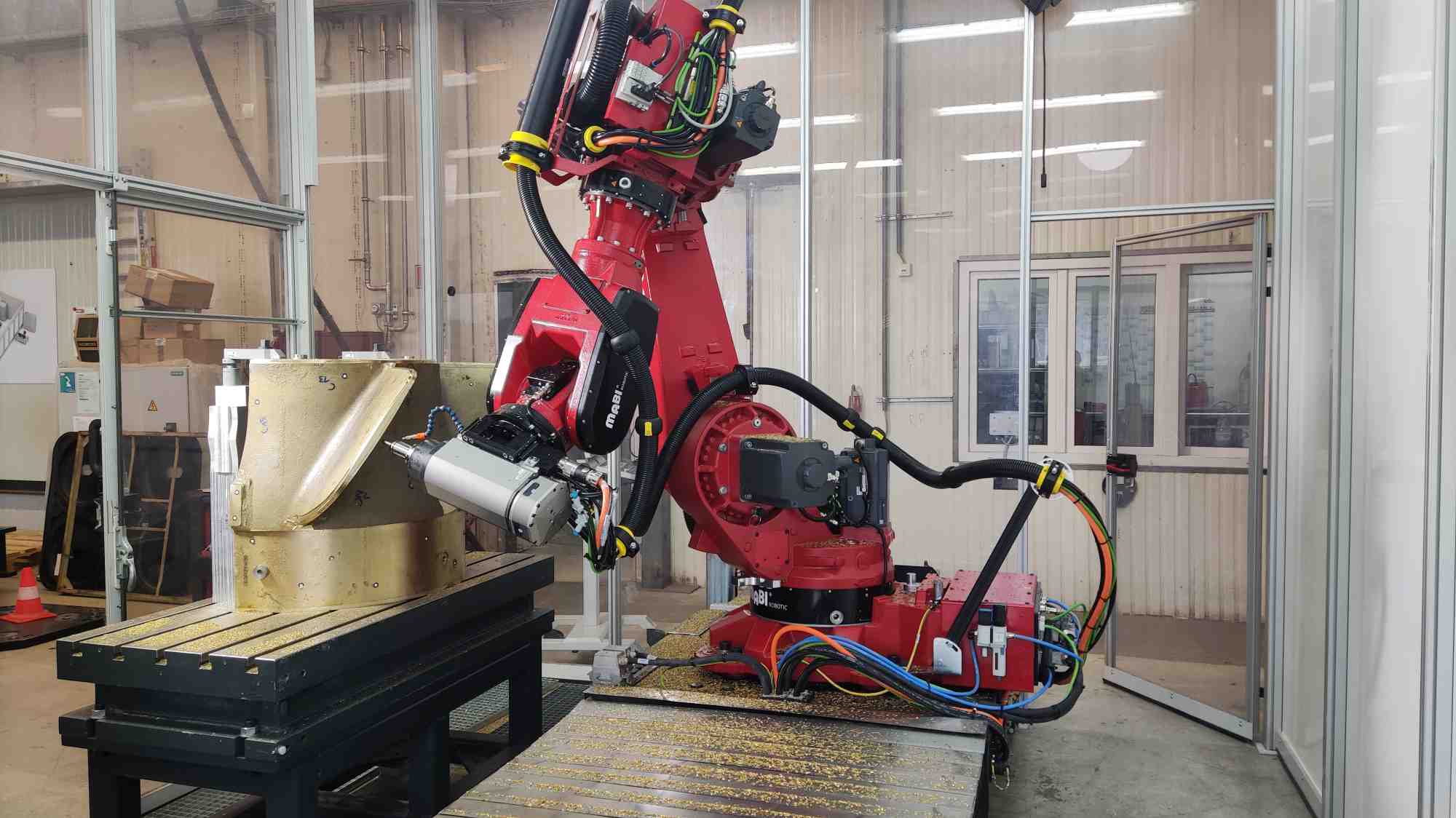
CNC robot for milling

MABI CNC robots are an innovative alternative to conventional milling machines. The use of CNC robots for milling, turning or grinding not only provides a precise, but also an efficient and cost-effective solution for metal processing.

The MAX Precision series robots impress with their high accuracy and stiffness. They achieve this through secondary encoders, which are installed on all axes. The system is controlled by the powerful SINUMERIK 840D sl or SINUMERIK ONE from Siemens. With the MAX-100, you can process wood, plastic, carbon fiber, aluminum, and steel.

Read more
arrow

Additive manufacturing

Additive manufacturing, also known as 3D printing, is a process by which three-dimensional objects are built up layer by layer. With conventional manufacturing methods, material is removed or molded. By adding material, shapes can be produced that are not possible with other methods. The CNC robots from MABI Robotic AG are the optimal tool for large objects.

CNC robots from MABI Robotic AG are the ideal tool for large objects. The large working area, combined with the high precision provided by secondary encoder technology, allows material to be applied layer by layer to large components. The flexibility of the robot platform allows you to switch between additive and subtractive processes in a cell.

Read more
arrow

Model and mold making

When developing prototypes, models are milled in original size in some areas. This gives you the advantage of being able to stand next to the object and get an impression of the finished design. Such models are most frequently used by the automotive industry to see the design of the vehicles in full size.

Compared to conventional portal milling machines, a lot of space can be saved — not to mention the significantly lower purchase costs. The purchase costs are significantly lower than those of portal milling machines with comparable accuracy. By using the MABI CNC robot cell, materials such as plastic, ureol, aluminum and other materials can be precisely machined.

Read more
arrow

Finishing of battery trays

Electromobility undoubtedly has a promising future. With the growing demand for environmentally friendly transportation and increased awareness of climate change, electric vehicles are becoming more and more important. An important factor for the future of electric mobility is to reduce production costs in order to make electric vehicles affordable for a broader section of the population.

The CNC robots from MABI Robotic enable the economical finishing of aluminum battery pans. Welded or die-cast tubs require post-processing of pockets, surfaces, holes and threads. MABI systems are a cost-effective alternative to large processing centers — with higher energy efficiency and lower infrastructure requirements.

Read more
arrow
Arrow left
arrow right
Max100 Spotlight

Ready-to-run: systems made in Switzerland

MABI Robotic provides complete ready-to-run systems. All components are optimally coordinated and specifically designed for manufacturing processes in metal processing. The experienced engineering team in Veltheim develops and manufactures every system in accordance with the highest Swiss quality standards.

What “ready-to-run” means:

  • Secondary encoder factory-integrated
  • Siemens SINUMERIK preinstalled and configured
  • Leica Laser Tracker Calibration Performed
  • WEISS milling spindle assembled and tested
  • Programming via Siemens NX CAD/CAM software with G-code post-processor

Standard robots must be retrofitted for CNC applications. The MAX series is factory-ready for production. The Swiss production depth and the know-how of the MABI Group guarantee short delivery times and direct support. From initial consultation to start-up, the team provides each customer with individual support.

Arrange a consultation now
arrow
References

MABI Robotic customers and partners are the most important component of success. The company has a steadily growing list of customers and projects that use the innovative robotics solution with secondary encoder technology

As a Swiss innovation leader in CNC robotics, MABI Robotic develops solutions that set new standards in precision and reliability. The references range from large industrial companies to medium-sized companies in various industries. MABI Robotic stands for high-quality and reliable CNC robots, which is reflected in the positive feedback and recommendations from customers.

From the automotive industry to aerospace to metal processing — the MAX series has proven itself in demanding production environments. Numerous successfully completed projects prove the team's competence and innovative strength.

Read more
Arrow rigth corner white
Siemens Energy Logo
BMW Logo
Broetje Logo

We are looking forward to you

If you would like to receive the latest information about our products and services or would like to be contacted by one of our employees, please fill out the form below with your company address.

contact us
arrow

Frequently asked questions

What distinguishes MABI CNC robots from standard robots?

As OEM robot systems, the MAX series industrial robots are equipped with secondary encoders on all six axes. As a result, they achieve significantly higher precision than conventional systems.

Overview of key differences:

Trait
MABI CNC robot
Standard robot
measurement system
Secondary encoders on all 6 axes
Encoders close to the motor only
Repeatability
±0.02 mm
Significantly lower
Stiffness
Specially developed for milling processes
Standard kinematics
Controller
Siemens SINUMERIK (CNC)
Robot control
Programming
G-Code
Teaching
Calibration
Leica Laser Tracker
Factory calibration

How the high path accuracy is achieved:

Through precise manufacturing tolerances and high measurement and testing costs, CNC robots achieve high-precision kinematics. In contrast to normal industrial robots, secondary encoders measure the position on both input and output shafts and compensate for twisting in real time. The combination of high-precision kinematics, secondary encoder and factory calibration with Leica Laser Tracker achieves peak path accuracy.

Why are CNC robots from MABI more expensive than standard robots?

The main feature of MABI CNC robots is their high precision. In order to achieve such a high level of accuracy, precisely tolerated components are required, which are significantly more expensive to manufacture.

Reasons for higher costs:

  • Secondary encoders on all axes — Optical measurement systems increase accuracy and production costs
  • precision components — Tight manufacturing tolerances for highly rigid kinematics
  • Factory calibration — Each system is calibrated with Leica Laser Tracker
  • Ready-to-run system — Complete system specifically designed for CNC applications

Industrial robots from other manufacturers are often not optimized for CNC controls or must be retrofitted. MABI Robotic delivers a production-ready system that is specifically designed for manufacturing processes in metal processing.

Which applications and materials are suitable for CNC robots?

CNC robots play a key role in the modern manufacturing landscape. They are primarily used in subtractive and additive manufacturing and can represent an economical alternative to portal milling machines due to their large working area.

main applications:

  • CNC milling — Precise 3D processing as a replacement for a milling machine
  • Additive manufacturing — Large-format 3D printing through layer-by-layer material application
  • Model and mold making — Full-size prototyping
  • Battery tray finishing — Post-processing for electric mobility

Workable materials:

  • aluminum — battery trays, structural components
  • steel (unalloyed and alloyed) — welded structures, toolmaking
  • wood and wood-based materials — model making at high speeds
  • synthetics and ureol — design models, fine surface quality
  • CFK (carbon fiber) — aerospace, lightweight construction

The MABI robots can be equipped with interchangeable tools: grippers for loading, deposition welding heads and milling spindles for surface processing. This flexibility makes it a suitable product for a wide range of manufacturing processes.

How are the CNC robots programmed?

Programming is carried out in G-code using Siemens NX CAM software — just like a conventional CNC milling machine.

Programming process in 5 steps:

  • Loading STEP file into CAM system
  • Define processing strategy (roughing, finishing)
  • Generate G-code with post-processor
  • Transfer code to SINUMERIK controller
  • Start automatic editing

The time-consuming teaching is completely eliminated. The open Siemens architecture enables integration into existing CAM workflows. CNC routers and production planners can work productively without retraining, as the programming is identical to conventional milling machines.

Training assistance:

MABI Robotic and qualified system integrators provide initial start-up support. The technical documentation provided facilitates familiarization. For more extensive projects, it is recommended to work with an integration partner.

What are the advantages of CNC robots compared to portal milling machines?

The economic efficiency of MABI CNC robots is reflected in several areas:

Cost advantage:
The investment costs are significantly lower than those of a comparable portal milling machine. CNC robots are an economical alternative to large processing centers.

Space requirement:
The space requirement is significantly lower. CNC robots do not require massive foundations and can be set up more flexibly.

energy efficiency:
Energy consumption is significantly lower than with portal milling machines, which reduces ongoing operating costs.

More benefits:

  • Flexibility through tool changes (milling + welding + handling)
  • Accuracy comparable to portal machines
  • Often the only economic solution for large components over 5 meters
  • Lower installation costs due to standard flooring
  • Shorter payback period

How large is the work area and can it be extended?

The working area of CNC robots can be modularly adapted to your requirements. The MAX-100-2.25-P has a range of 2.25 meters.

Expansion options:

With the MLR-2500-P linear axis, the working range is extended to 6 x 2 meters. The linear axis can be extended modularly in steps of 3 or 5 meters, so that even significantly larger workpieces can be processed.

Customizability:

The CNC robots are designed in such a way that they can be extended with interfaces and accessories for special applications:

  • Interchangeable tools — Grippers, deposition welding heads, milling spindles depending on the task
  • linear axes — Extension of the working radius for large workpieces
  • Rotating-swivel tables — Flexible workpiece positioning during processing

The basic structure or kinematics of CNC industrial robots is offered in certain model variants. Adjustments are made via peripheral extensions (tools, axes, software), so that, despite a standardized robot platform, maximum flexibility is provided for customer-specific applications.

The repeatability of ±0.02 mm remains constant even with large working areas.

Who is MABI Robotic and where are the CNC robots produced?

MABI Robotic AG is a leading Swiss company and manufacturer of CNC robots and high-precision automation solutions. The specialty is the combination of machine tools with robotics in order to achieve maximum productivity, maximum accuracy and maximum flexibility in production.

Swiss production:

All CNC robots and automation systems from MABI Robotic are developed, produced and tested entirely at the main plant in Veltheim (canton of Aargau, Switzerland). Manufacturing in Switzerland ensures that Swiss precision and quality standards are met.

Product portfolio:

  • High-precision CNC industrial robots (6-axis robotic arms)
  • Linear axes to extend the range
  • Rotate/swivel tables for flexible workpiece positioning
  • Robot controllers (based on Siemens SINUMERIK) and accessories

Local production and assembly enable short delivery routes and continuous quality control — from the first component to the fully calibrated CNC robot.

Which certifications and quality standards does MABI Robotic comply with?

MABI Robotic AG is ISO 9001 certified. This means that quality management is tested in accordance with international standards. This certification confirms that MABI Robotic has implemented systematic quality assurance processes and is continuously monitoring them.

Production quality standards:

  • ISO 9001:2015 — Certified quality management system
  • Strict manufacturing guidelines — All CNC robots are manufactured according to defined quality and safety standards
  • Factory calibration — Leica laser tracker calibration for each robot (100-200 measurement points)
  • Documented processes — Full traceability of all components
  • final test — Each system is tested and approved before delivery

Swiss production quality:

Local development, production and assembly in Veltheim guarantees the highest quality standards. The Swiss manufacturing tradition and the know-how of the MABI Group flow directly into every system. This ensures maximum reliability and durability of CNC robots.

CE compliance:

All systems comply with European CE guidelines for machinery and electrical safety. The documentation includes all required declarations of conformity and technical documentation.

Does MABI Robotic offer training for CNC robots?

Yes, MABI Robotic attaches great importance to customers being able to use CNC robots optimally. For this reason, practical live demonstrations and feasibility studies are offered at the Veltheim plant.

Training offer:

When buying a robot, it is possible to book training courses. These trainings can be carried out either directly at the factory in Veltheim or after installation at the customer's site — whichever is more practical.

Training content:

  • basic functions — Operation of the Siemens SINUMERIK controller
  • programming — G-code creation and CAM integration
  • Advanced techniques — Optimization of processing strategies
  • servicing — Preventive maintenance and fault diagnosis
  • surety — Safe handling of the CNC robot

Particularly easy incorporation:

The operation of the MABI CNC robots is very intuitive thanks to the familiar Siemens SINUMERIK CNC controller. Since the robots are controlled with SINUMERIK 840D sl/ONE, many CNC specialists are already familiar with the user interface from the world of machine tools. This makes training much easier and reduces training time.

The training courses provide both theoretical knowledge and practical skills so that the team can operate the robot safely and efficiently.

Are CNC robots collaborative robots (cobots)?

No, the CNC robots from MABI Robotic are no collaborative lightweight robots (cobots). They are designed for industrial use in secure production environments.

Difference from cobots:

Trait
MABI CNC robot
Cobots
Payload
100 kg (MAX-100-2.25-P)
Typically 5-20 kg
Area of application
Industrial processing
Easy assembly, handling
Safety concept
Secured cells, protective fences
Direct human-robot contact
Precision
±0.02 mm (secondary encoder)
±0.05-0.1 mm
Processes
Milling, grinding, welding
Pick & place, screws
Controller
Siemens SINUMERIK (CNC)
Robot control

Why no cobots:

The MABI CNC robots are designed for high-load machining processes that involve high process forces. The load capacity of 100 kg and the powerful WEISS milling spindles (up to 16.5 kW) require robust kinematics and appropriate safety measures.

Safety standards:

Nevertheless, CNC robots have state-of-the-art safety functions: a Cartesian safety system with freely definable virtual protection areas and a fail-safe PLC (safety controller), which constantly monitors robot movements. However, for fully automated operation, the robot must be integrated into a suitable protective environment (robot cell).

All MABI systems comply with CE guidelines for machine safety and are certified for industrial use. The installation requires a risk assessment and appropriate protective devices in accordance with ISO 10218 (industrial robots).

How can the CNC robots be tested before they are purchased?

MABI Robotic offers various ways to get to know and test CNC robots before making an investment decision.

Live demonstration in Veltheim:

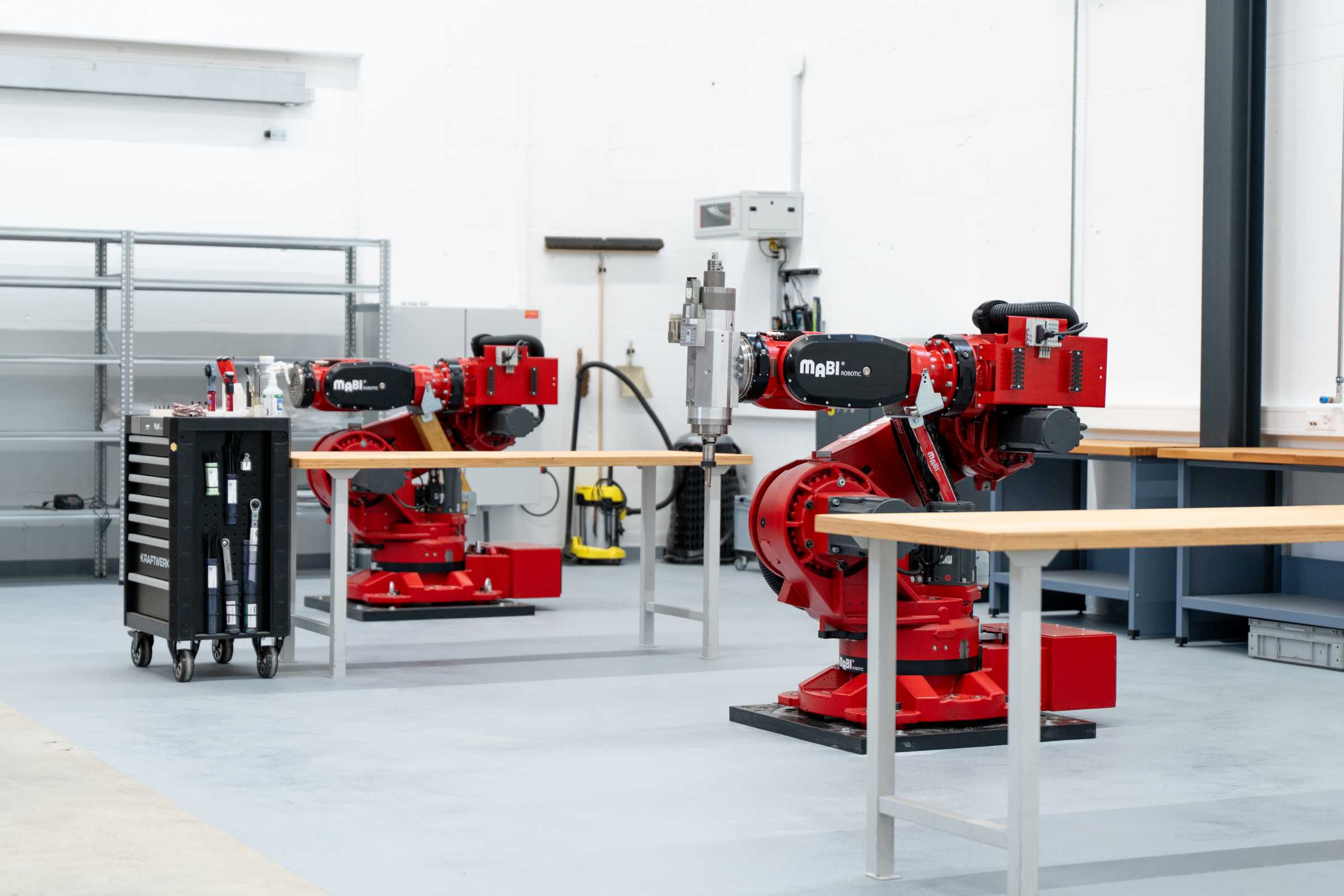
At the headquarters in Veltheim, Switzerland, interested parties can Milling robot Experience it live in the demonstration cell. The MAX-100-2.25-P is used there and demonstrates the performance of secondary encoder technology in practice.

Feasibility study:

MABI Robotic offers feasibility studies for customer-specific applications. It is examined whether and how specific processing projects can be implemented with CNC robots. MABI works together with renowned institutes and universities. Interested parties and customers can have their own materials or processes tested on site.

Partner demonstrations:

Alternatively, MABI Robotic is happy to recommend one of the qualified partners for a demonstration or feasibility study nearby. The demonstrations include typical applications such as milling, deposition welding or additive manufacturing.