

Not every installation can be brought to the machine. Completed cargo ships, refinery components, wind turbines, or large aerospace parts are simply not transportable when they require repair or processing. Until now, this meant either manual work with angle grinders and welding equipment, or costly disassembly and shipping of the affected parts to a stationary manufacturing facility.
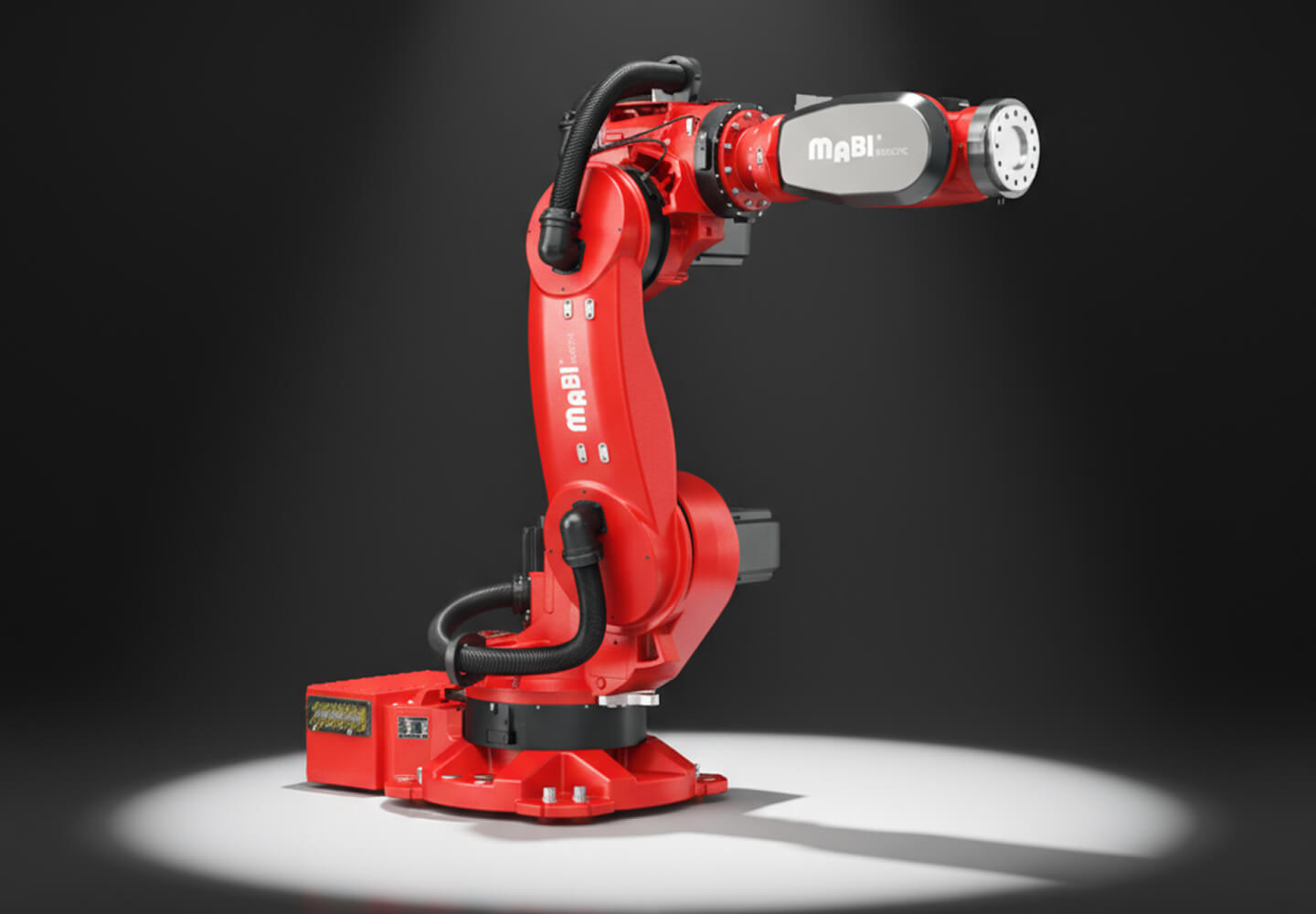
MABI Robotic AG develops CNC robots for precisely this scenario. The robotic arm is mounted on a mobile platform and brought directly to the installation, ship, or machine. On-site processing, without disassembly, without transport.
The Problem: Large installations cannot be disassembled
Large industrial installations and ships have one thing in common: they are completed at their operational site and cannot simply be transported to a workshop for post-processing or repairs. All previous options involve considerable effort:
- Manual processing with angle grinders, welding equipment, or hand tools, imprecise and labor-intensive
- Disassembly of affected components, shipping to a manufacturing service provider, return transport, and reassembly
- Use of heavy, stationary gantry systems, costly, inflexible, and tied to the processing location
None of these solutions are efficient. Especially for time-sensitive repairs, such as on a cargo ship in port, every hour counts. Furthermore, in certain environments like refineries, chemical plants, or offshore structures, manual work involves significant safety risks.
Mobile Milling Robot Instead of Disassembly
The answer to this problem is a mobile CNC robot system. The milling robot is transported on a stable platform and positioned directly at the operational site. There, it performs milling, drilling, and welding tasks that previously could only be done manually or not automated at all.
The advantages over conventional methods are clear:
- On-site processing, no disassembly of components to be repaired necessary
- Higher precision than manual processing with handheld tools
- Shorter downtime for the installation or ship
- Repeatable, documentable processing quality
- Use in environments where manual work is difficult or dangerous
Fraunhofer IFAM and MABI Robotic: Mobile Machining in Aircraft Construction
A concrete example of mobile CNC machining is provided by the joint project between MABI Robotic AG and the Fraunhofer Institute for Manufacturing Technology and Advanced Materials IFAM. As part of this project, a mobile robotic arm was developed that autonomously approaches raw components in aircraft construction and performs all necessary work steps, including milling, drilling, and measuring.
Crucial for achieving accuracy: output-side measuring systems on the robot axes. While conventional industrial robots have their measurement technology attached to the motor, output-side measuring systems measure directly on the axes, compensating for gear compliance in real-time. This aligns with the principle of secondary encoder technology, which MABI Robotic consistently employs across its entire MAX series. The processing deviations of the mobile system are less than half a millimeter, a precision absolutely essential in aircraft construction. The CNC robot moves to the target position on a rigid platform with three drive wheels, then retracts the wheels and stands stably.
The system was publicly demonstrated at Hannover Messe 2018, including on the vertical stabilizer of an Airbus 320.
Applications of mobile CNC robotic systems
The principle of the mobile milling robot is not limited to aircraft construction. Wherever large or permanently installed structures need to be processed, repaired, or reworked, a mobile CNC system offers clear advantages over manual methods:
- Shipbuilding and maritime industry: Repairs to hulls, propulsion components, or deck structures of completed cargo ships directly in port
- Energy sector: Post-processing and repair of components in refineries, power plants, or wind turbines
- Aviation: On-site processing of large-format structural components such as fuselage sections or tail units in the assembly hall
- Heavy Machinery Manufacturing: Milling and welding work on large machines that cannot be dismantled
- Offshore and Industrial Plants: Machining in environments with restricted access profiles or increased safety requirements
Risk Reduction in Hazardous Environments
An aspect often underestimated in discussions about mobile robotics is occupational safety. Manual repairs in refineries, on offshore platforms, or within confined ship hulls involve significant risks for the personnel involved. Heat, fumes, cramped conditions, and the use of cutting and welding tools create a hazard potential that can be directly reduced through automation.
A mobile CNC robot performs these tasks precisely and repeatedly, without personnel needing to be permanently present in the danger zone. This is not only a safety argument but also an economic one: less protective effort, lower insurance risks, shorter deployment times for specialized personnel.
What technically defines a mobile CNC robot
The technical requirements for a mobile machining robot are higher than for a stationary system. The following characteristics are crucial:
- Precision despite changing setups: Secondary encoder technology compensates for deviations through direct measurement on the axes
- Stiffness under load: The robot arm must absorb milling and welding process forces without losing accuracy
- CNC Control: The Siemens SINUMERIK control allows G-code programming, familiar machine tool logic without teaching
- On-site calibratability: Factory calibration with a laser tracker provides the basis for reproducible results, even in mobile applications.
- Modular expandability: Tool changes between various end effectors, such as a milling spindle or (cladding) welding head, directly on-site
Conclusion: The machine comes to the workpiece, not the other way around.
Stationary manufacturing systems have their place, but they require the workpiece to be brought to the machine. For large, permanently installed systems, this is not an option. Mobile CNC machining solves this problem directly: it's more precise than manual machining, faster than disassembly and shipping, and safer for the personnel involved.
MABI Robotic AG develops and produces Milling robots with secondary encoder technology and Siemens SINUMERIK control, which are designed for demanding machining tasks in industrial environments. The joint project with Fraunhofer IFAM demonstrates that this technology functions reliably even under the high precision requirements of mobile applications.


